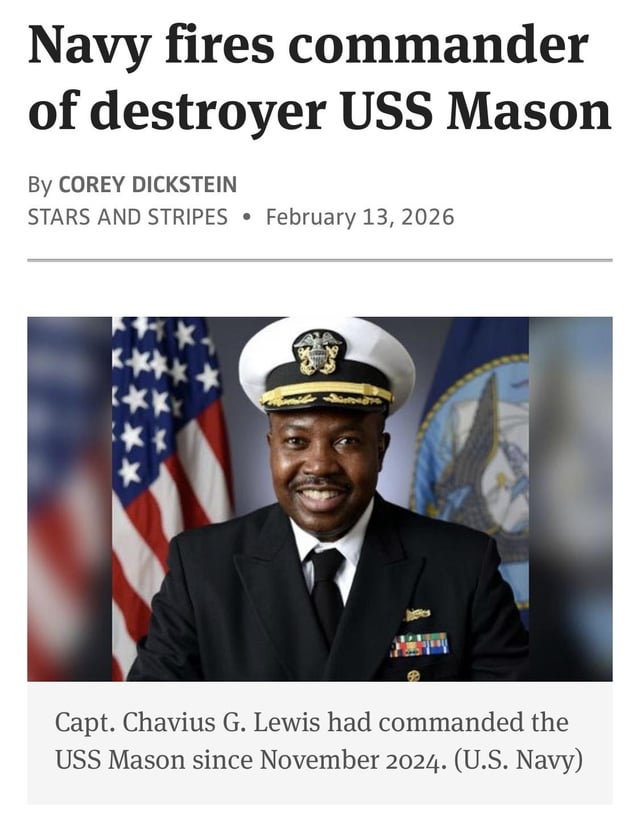
Navy Relieves USS Mason Captain Amid Critical Training Drills: A Deep Dive into Leadership Accountability
In a significant move that underscores the U.S. Navy's unwavering commitment to its rigorous leadership standards, the commanding officer of the guided-missile destroyer USS Mason (DDG 87), Captain Chavius G. Lewis, was relieved of his duties on February 13. The decision, made by Rear Admiral Alexis T. Walker, Commander, Carrier Strike Group 10, cited a "loss of confidence" in Captain Lewis's ability to command. This high-profile leadership change comes at a particularly critical juncture, as the USS Mason is actively engaged in the Composite Training Unit Exercise (COMPTUEX), a vital precursor to its upcoming deployment.
The relief of a commanding officer, especially during such an intensive and crucial training phase, inevitably sparks questions and highlights the immense responsibilities placed upon naval leaders. While the Navy maintains that the leadership transition will not impact the ship's mission or schedule, the ripple effects of such a decision can extend deep within the crew and the broader fleet. Understanding the implications requires looking beyond the official statements to the unique pressures of military command and the nuanced meaning behind a "loss of confidence."
The Event Unfolds: A Sudden Shift in Command
The announcement of Captain Lewis's relief was direct and succinct. Rear Admiral Walker’s decision to remove Captain Lewis from his post as the Navy USS Mason Commander Fired came on February 13, just a few months after Captain Lewis had assumed command of the destroyer on November 14, 2024. Following his dismissal, Lewis has been temporarily reassigned to Commander, Naval Surface Group Southeast. Stepping into the critical role immediately is Captain Kevin Hoffman, who now serves as the Mason's commanding officer, tasked with seamlessly guiding the ship through its ongoing training and preparations for deployment.
At the time of the relief, the USS Mason was fully immersed in COMPTUEX within the U.S. 2nd Fleet area of operations. This exercise is designed to test a ship's and its crew's readiness across a spectrum of complex and high-stress scenarios, simulating real-world operational challenges. The timing of Captain Lewis's removal during such a pivotal exercise underscores the immediate and non-negotiable nature of leadership performance expectations within the Navy.
Deconstructing "Loss of Confidence": More Than Just a Phrase
The phrase "loss of confidence" is frequently employed by military services when relieving high-ranking leaders, often without further elaboration. This ambiguity serves multiple purposes: it protects privacy, avoids premature judgments, and maintains operational security. However, it also leaves room for speculation and can generate unease, both within the ranks and among the public. For a deeper understanding of this standard naval terminology and its implications, you can read more about USS Mason Commander Fired: What "Loss of Confidence" Means.
In essence, a "loss of confidence" does not necessarily imply misconduct or a specific breach of regulations. Instead, it often points to a perceived failing in overall leadership ability, judgment, decision-making, or the effective management of the command environment. It signifies that the superior officer no longer believes the individual possesses the necessary qualities or has demonstrated the required performance to effectively lead their unit. This could stem from a pattern of issues, a single critical incident, or a perceived inability to instill proper training standards, accountability, or morale within the crew.
- Focus on Leadership Acumen: It’s a judgment on the leader's capability to inspire, manage, and direct effectively.
- Preventative Measure: Often, it's a proactive step to prevent potential future issues or mitigate existing risks.
- High Stakes: Given the critical nature of naval operations, any perceived weakness in command can have severe consequences, making swift action imperative.
The Crucible of COMPTUEX: Why Timing Matters
The Composite Training Unit Exercise (COMPTUEX) is not merely a routine drill; it is the ultimate stress test for a naval vessel and its strike group before deployment. During COMPTUEX, ships and their crews are pushed to their limits, facing simulated enemy attacks, complex tactical scenarios, humanitarian aid missions, and a myriad of other challenges designed to mirror real-world combat and crisis situations. It’s a period of intense scrutiny, where every aspect of a ship's readiness – from engineering to combat systems, and most importantly, command and control – is evaluated.
For the Navy Uss Mason Commander Fired during such a crucial exercise, the decision highlights the absolute premium placed on leadership performance under pressure. Any hesitation, misjudgment, or perceived deficiency in leadership effectiveness can unravel the collective efforts of hundreds of sailors and jeopardize the readiness of an entire strike group. The fact that the change occurred mid-exercise underscores the Navy's view that immediate corrective action was necessary to ensure the Mason, and by extension, Carrier Strike Group 10, remained on track for mission success.
Ripple Effects: Impact on Crew and Continuity
While the Navy asserts that Captain Lewis's relief will not impact the USS Mason's mission or schedule, the reality on board a destroyer can be more complex. A commanding officer is the heart and soul of a ship, responsible for setting the tone, upholding training standards, enforcing accountability, and fostering morale. Any abrupt leadership transition, especially one shrouded in the ambiguity of "loss of confidence," can inevitably stir things up among the crew.
Sailors might experience a range of emotions, from unease and speculation about the reasons behind the change to a renewed sense of accountability and a reinforced belief in the Navy's high standards. The incoming commanding officer, Captain Hoffman, faces the immediate challenge of not only maintaining operational continuity but also quickly establishing trust, clarity, and a stable command environment. Effective communication, visible leadership, and a steady hand become paramount in mitigating potential disruptions and ensuring the crew remains focused on their demanding tasks. For a more detailed look at how such changes affect those onboard, explore our article on Leadership Shake-Up: USS Mason Commander Firing & Crew Impact.
Practical steps an incoming commander might take include:
- Open Communication: Addressing the crew directly and reassuring them about continuity and mission focus.
- Visible Presence: Being present throughout the ship, engaging with sailors at all levels.
- Reinforcing Standards: Clearly articulating expectations for performance and behavior.
- Team Building: Emphasizing unity and collective purpose to overcome the transition.
The Broader Message: Naval Leadership and Accountability
The decision to relieve Captain Lewis serves as a stark reminder of the immense responsibilities and constant scrutiny faced by naval commanding officers. The Navy operates under a unique ethos where the stakes are inherently high – national security, the lives of service members, and billions of dollars in assets. Consequently, the standards for leadership are exceptionally stringent. This incident reinforces the Navy's commitment to holding its leaders accountable when those standards are not met, irrespective of an officer's past record or the timing of the perceived deficiencies.
Captain Lewis's career path, commissioned through Officer Candidate School in 2000 and having previously commanded two littoral combat ships, illustrates that even seasoned officers with a strong background can face such a critical evaluation. This event is not an isolated incident but part of a continuous process by which the Navy strives to ensure only the most capable leaders command its most vital assets. It's a testament to a culture that prioritizes mission readiness and the well-being of its sailors above individual tenures.
Conclusion
The relief of Captain Chavius G. Lewis as the commanding officer of the USS Mason during critical pre-deployment training exercises is a powerful demonstration of the U.S. Navy's unwavering dedication to leadership excellence and accountability. While the "loss of confidence" explanation remains intentionally broad, it underscores the profound responsibility entrusted to those who command naval warships. The timing of this decision during COMPTUEX highlights the immediate and non-negotiable requirement for peak leadership performance under pressure.
As Captain Kevin Hoffman steps in to lead the USS Mason, the focus remains firmly on maintaining mission readiness and ensuring the crew's morale and effectiveness. This incident serves as a crucial reminder for all leaders, military and civilian alike, that effective leadership is a continuous performance, constantly evaluated, and directly tied to the success and safety of those under command. The Navy's swift action reaffirms its commitment to upholding the highest standards, ensuring its fleet remains prepared for any challenge on the global stage.